
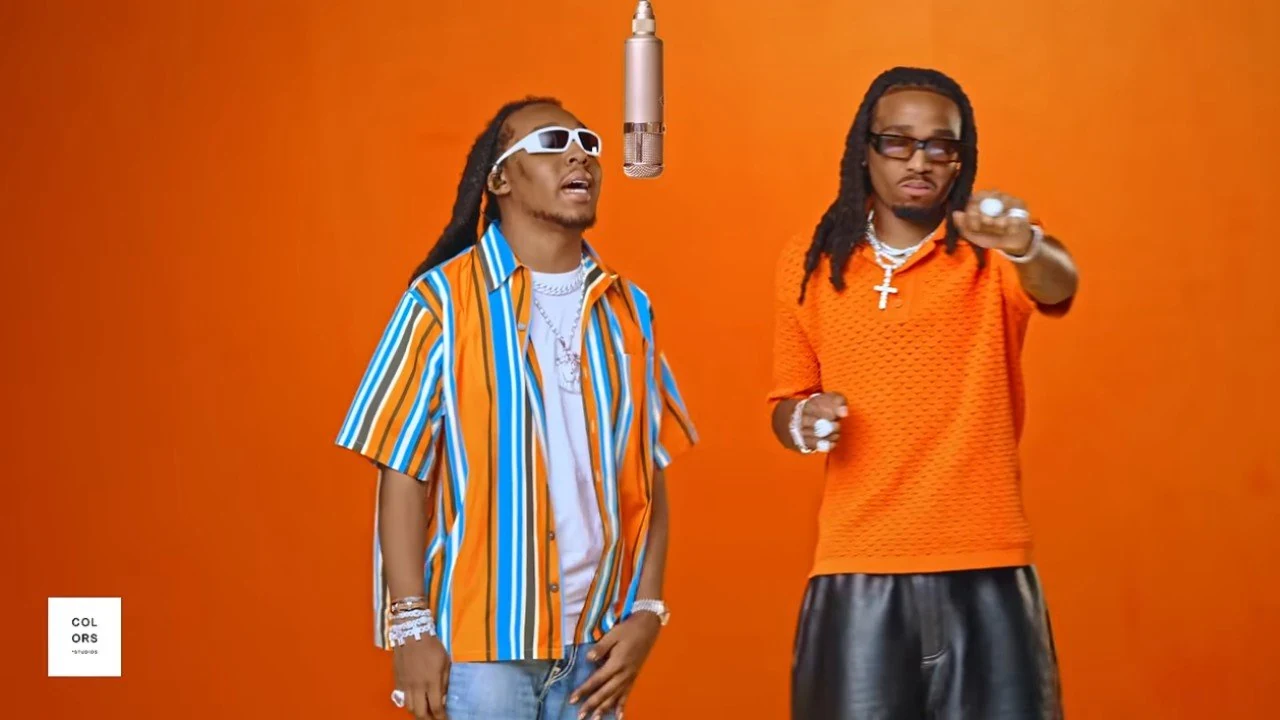
A wave of AI videos with the same unmistakable setup has been spreading recently: an orange background, two performers, and a hanging microphone. The people in the frame might be movie characters, anime characters, celebrities, or even animals, while the movement and camera rhythm stay nearly the same.
That is what people are referring to as Hotel Lobby AI. It is more than a face replacement. The effect uses the motion and structure of an existing video, then regenerates the people in the scene as different characters.
What is Hotel Lobby AI?
Hotel Lobby AI is a form of character swap built from an existing video. The source video provides the movement, positioning, camera work, and timing. AI then regenerates the people in the scene from new character references.
The name comes from the Quavo and Takeoff COLORS performance of “Hotel Lobby”, which became the most recognizable template for the trend. Its flat orange background, two performers, and central hanging microphone make the clip easy to recognize even after the people are replaced.
Tools such as Higgsfield Genjutsu use Motion Transfer to preserve the movement, camera motion, and timing of a reference video while rebuilding the characters from new reference images.
In simple terms:
The source video decides how the scene moves. The reference images decide who performs it.
Why it looks different from a traditional face swap
Traditional video face swap usually tries to keep the original body, clothing, and background intact while replacing mainly the face.
Character swap can change much more of the person. A regenerated character may have a different face, hairstyle, clothing, body appearance, or overall visual style. A real person can even become an animated character or an animal while following the same motion.
So the result is not simply “the original person with a different face.”
It is closer to:
A different character performing the same actions as the person in the source video.
That is why many newer AI videos are still casually described as face swaps even though the visible transformation goes far beyond the face.
Why Hotel Lobby works so well for character swap
The template works partly because it is visually simple.
The orange background has almost no distractions. Both performers stay near the center of the frame, and their movements are easy to read. As long as the background, microphone, and performance rhythm remain recognizable, viewers can still identify the Hotel Lobby template even when the people are completely different.
The two-person format also creates endless combinations.
It can be two movie characters, two football stars, two anime characters, or two cats. The scene stays familiar while the people inside it keep changing.
That combination of a fixed visual template + constantly changing characters makes the format especially effective for memes and short-form video.
How Hotel Lobby AI differs from real-time character swap
The common Hotel Lobby AI workflow still starts with a video that has already been recorded:
Existing video → character references → AI generation → new video.
The performance has already happened. AI is rebuilding the people inside that performance.
Real-time character swap works differently. The movement comes from a live camera instead of a prerecorded clip.
If the person in front of the camera turns, raises a hand, or changes pose, the AI output has to keep responding to those movements as they happen. In LiveFaceSwap AI, the person in the camera can be transformed into different people, characters, or visual styles in real time without first recording a motion reference video.
| Hotel Lobby-style character swap | Real-time character swap |
|---|---|
| Starts from an existing video | Starts from a live camera |
| Motion is already recorded | Motion is happening now |
| You watch the result after generation | You see the result while moving |
| Best suited to memes, short videos, and edited content | Best suited to streaming, video calls, and live creation |
The simplest distinction is:
One remakes a video that has already happened. The other changes a video while it is happening.
If the whole character changes, why is it still called face swap?
Because face swap is still the phrase most people already understand.
But as generative video systems rebuild more of the person, the capability is expanding toward character swap. The face may be only one part of the transformation; hair, clothing, body appearance, and visual style can change as well.
For now, both terms are likely to stay useful:
- Face Swap quickly communicates the familiar idea of appearing as someone else.
- Character Swap more accurately describes a transformation that changes the full person or character.
Hotel Lobby AI matters for more than the orange-background meme itself.
It makes one shift in AI video easy to see: “swapping someone” is moving from replacing a face to regenerating an entire character.
And when that same kind of transformation no longer depends on a prerecorded source video, but instead follows a camera live, the experience changes from “making an AI video” to “performing as another character in real time.”